| Dates | 3 May to 7 May 2027 |
| Location | Jersey, Channel Islands |
| Tour organiser | Anna Bradstock |
| Tour coordinator | Anthony Dessain |
| Difficulty rating | Level 2: Easy, with some longer walks and occasional uneven ground |
| Max. participants | 25 |
Send to: Anna Bradstock
Send to: Anna Bradstock
Send to: Anna Bradstock
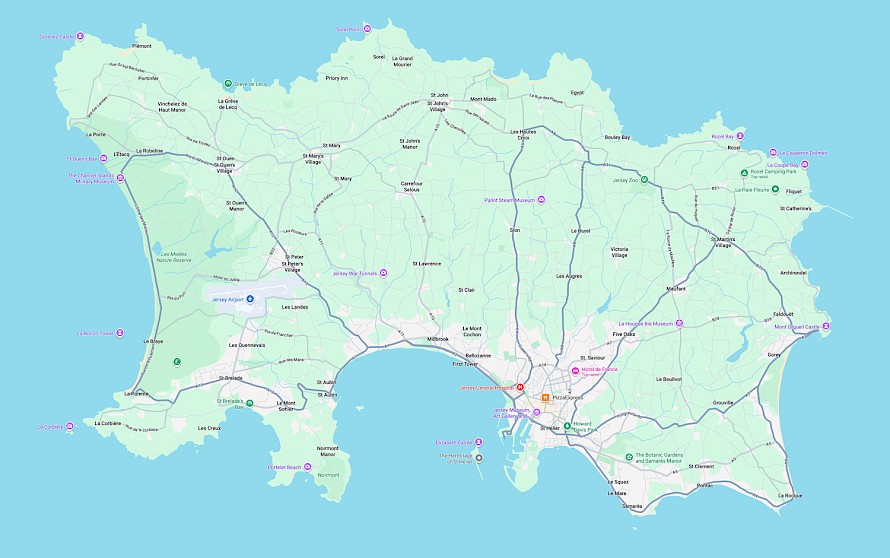
‘Neither French nor English’, Jersey is a Crown Dependency, the largest of the Channel Islands and the most sunny and southerly part of the British Isles looking towards France just 18 miles away. The Island’s 45 square miles offers a surprisingly diverse and contrasting landscape sloping southwards from granite cliffs in the north, to a sandy southern coastline.
We will visit gardens designed with tender and exotic trees thriving in the maritime climate of the Gulf Stream, some in the valleys and streams running north to south, sheltering from prevailing south-westerly winds, others taking on the challenge to command spectacular sea views.
We have selected four manor houses of Norman origin and British influence, where trees escaped the extensive felling during the German Occupation in the Second World War, late Regency houses reflecting the prosperity of the nineteenth-century cod fishing trade, gardens of the post-war influx of knowledgeable plantsmen and our Arboretum first planted in the 1970s.
Jersey IDS members will kindly host some of the visits and Jersey Trees for Life will be proud to show their collection at Val de la Mare Arboretum, including a group of four critically endangered Glyptostrobus pensilis, from which Tom Christian recently harvested seed.
We will stay in the heart of the Island at the traditional pink granite Greenhills Country House Hotel and Restaurant, voted 5th Best Hotel in the British Isles by Tripadvisor in 2025.
Arrival in Jersey
Greenhills Hotel is a short taxi journey from the airport or 15 minutes drive from the ferry terminal in St Helier.
Evening
We will gather for welcome drinks at the home of Shirlie Brownlow, Maison des Pres, right next to Greenhills Hotel.
Dinner at Greenhills hotel in a private dining room.
Morning
Depart Greenhills by coach 9.15 am
Val de la Mare Aboretum
We begin our Jersey tour at the Island’s flagship arboretum: Val de la Mare, a remarkable landscape cared for by Jersey Trees for Life. Alex Morel (CEO and IDS member) and Ben Parkes (Tree & Hedgerow Manager) lead the organisation with vision and energy, driving its mission to protect, plant, and champion trees across Jersey. Both have been instrumental in restoring the arboretum following the severe damage inflicted by Storm Ciarán in November 2023.
Established in 1975 through a generous donation from the Moores family, the arboretum was originally planted with carefully sourced seed by the States of Jersey. When initial funding ended, maintenance declined and the site became heavily overgrown. A new phase began in 2012, when Jersey Trees for Life entered into partnership with Jersey Water, which manages the adjacent reservoir. Today, with growing volunteer support, the arboretum is once again flourishing and remains free for the public to enjoy.
Covering 23.5 acres, the arboretum contains ten distinct geographic and thematic tree collections.
Our route begins in the Australasian collection where we find Eucalyptus spp. Hoheria spp., Sophora microphylla, Callistemon spp., Callistris oblonga, Leptospermum scoparium, Lomata myricoides, Podocarpus nivalis and Dicksonia antarctica. We will pass the critically endangered Colchagua myrtle, Myrceugenia colchaguensis, endemic to Chile.
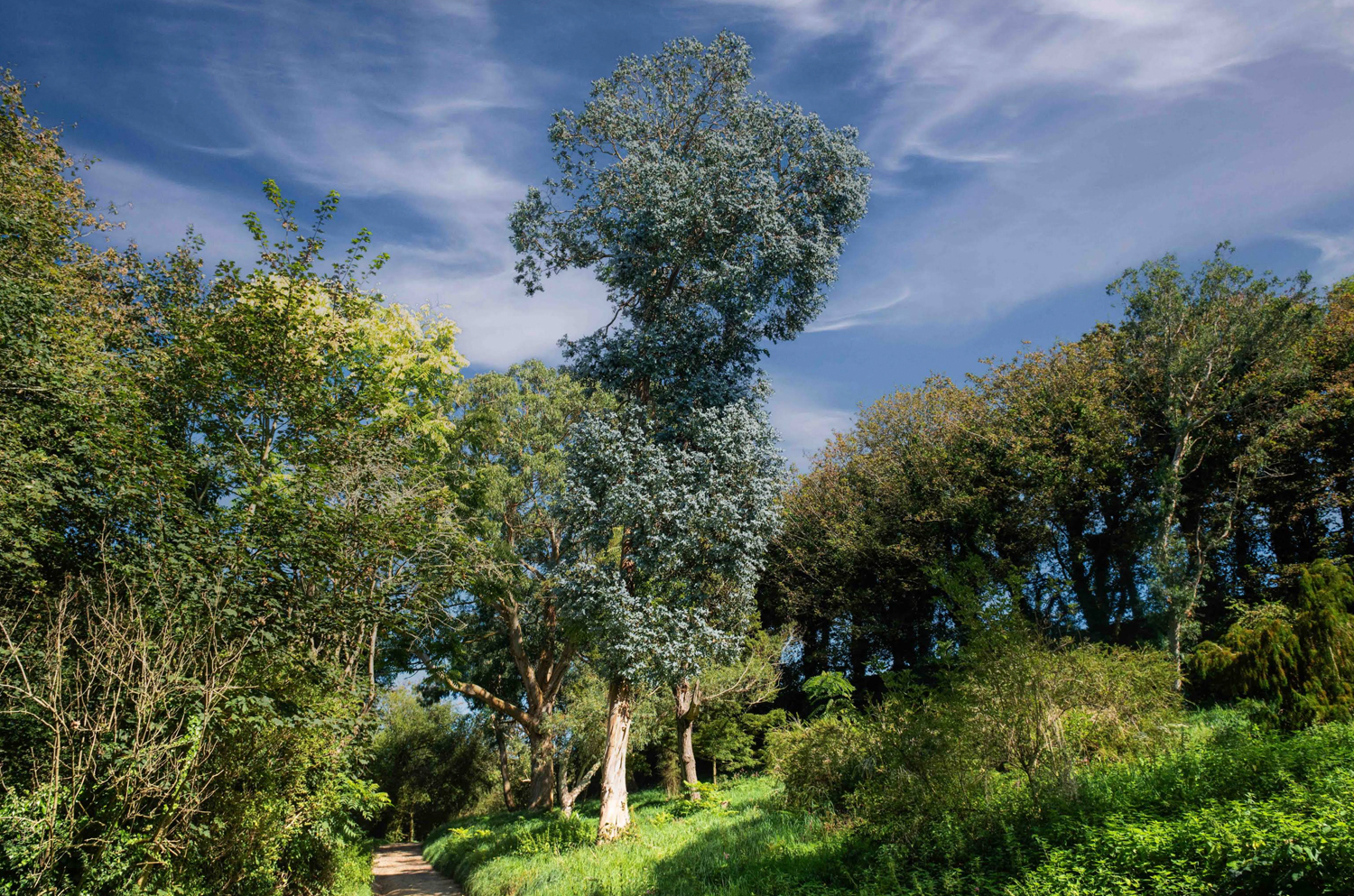
Australasian collection, Val de la Mare Arboretum
We then enter the North American collection, home to a rich variety of mature American oaks and several young maples. In the swampy ground beyond a stand of willow lies a striking group of four Glyptostrobus pensilis, notable for their impressive, buttressed bases and reliable seed production.
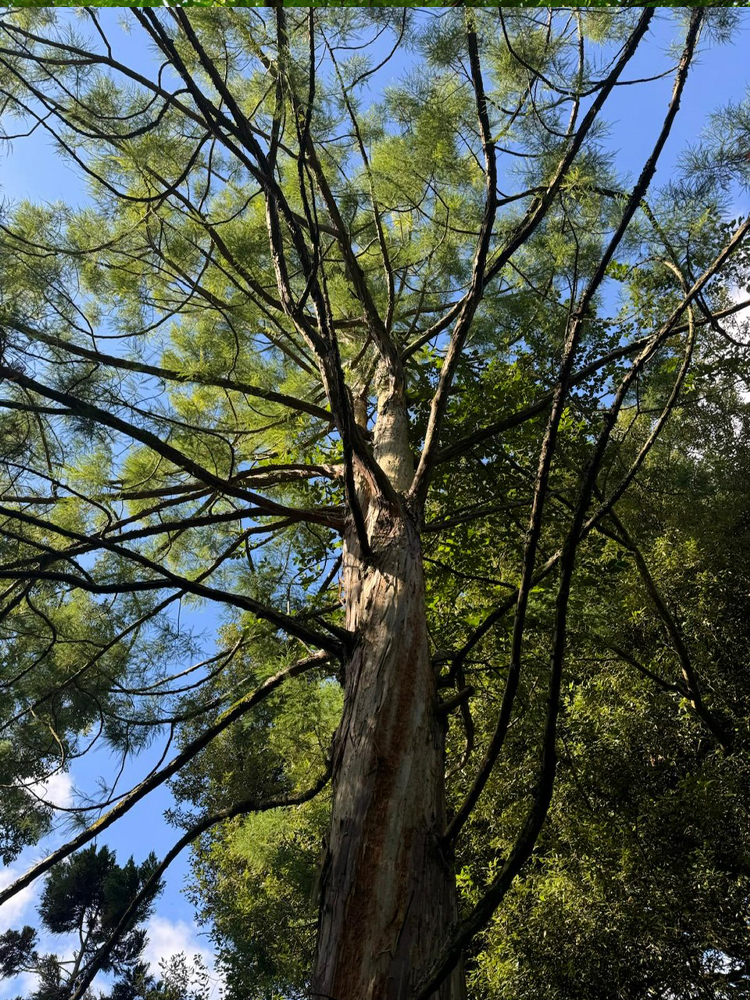
Glyptostrobus pensilis
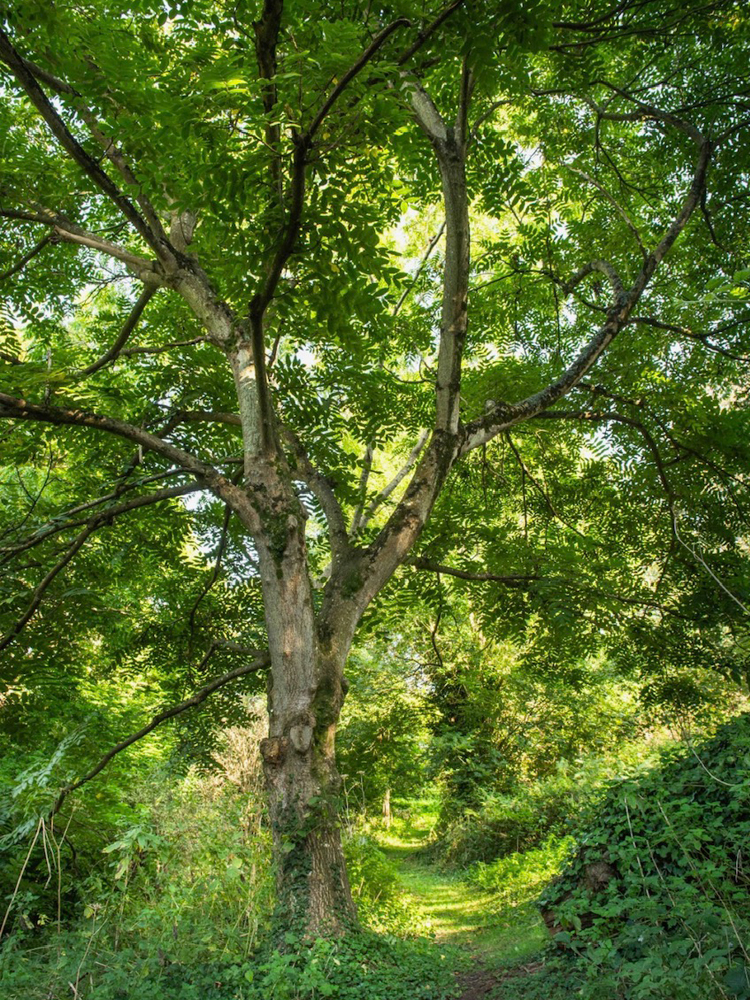
Juglans mandschaurica
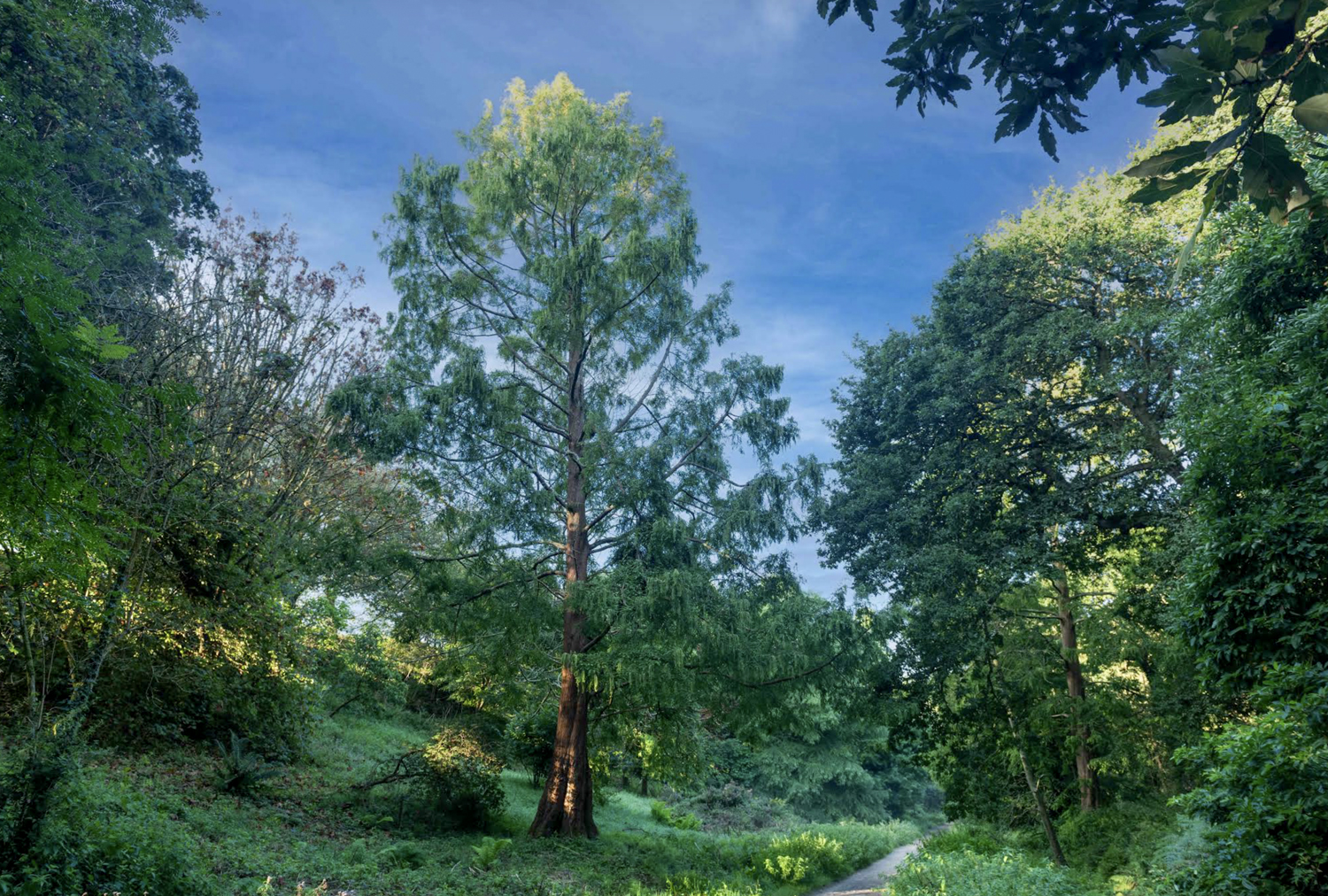
American collection, Val de la Mare Arboretum

Tom Christian in Val de la Mare on a seed collecting trip for Glyptostrubus pensilis
Continuing past the reservoir, we descend into a narrow valley fed by a stream that sustains towering Pterocarya rhoifolia, Pterocarya fraxinifolia and Juglans spp.
Exiting the valley, a fruit and nut collection has been recently planted, trialling species adapted to warmer climates and Jersey’s increasing sunshine hours; Hovenia dulcis (Japanese raisin tree), Punica granatum and Prunus dulcis.
From here, we descend through the Chinese collection, enjoying views of the reservoir framed by Acer spp. and Magnolia spp. including Magnolia dawsoniana, M. zenii, and M. officinalis var. biloba., Kalopanax septemlobus and Sinojackia xylocarpa.
A brief stop in the Japanese collection allows us to admire Cryptomeria japonica ‘Lobbii’ before we continue into an elm trial area dating from the 1980s. Here, first‑generation Dutch elm disease-resistant hybrids such as Ulmus ‘Regal’, Ulmus × hollandica ‘Plantijn’, and Ulmus ‘Sapporo Autumn Gold’ now stand as mature 40‑year‑old specimens.

Cryptomeria japonica ‘Lobbii’
Our return route leads us above the pinetum, offering views of Pinus montezumae and Pinus parviflora. We re‑enter the oak collection, where highlights include the elegant Quercus myrsinifolia, Quercus glauca, and a large Quercus robur, a survivor of the widespread tree felling during the German occupation.
Lunch
Oaklands
Simon and Melissa Bonn are generously hosting a light lunch for us today where we can remember Simon’s parents, Michael and Elizabeth, both IDS members and Michael, President of the IDS in the early 1990s. They returned to live at Oaklands in 1976, a very different landscape in those days, as his father had a Jersey dairy herd and kept his bull in a field which is now the front lawn. The wide variety of species in this garden were inspired by their frequent IDS trips and many of the trees were grown by Michael from seed.
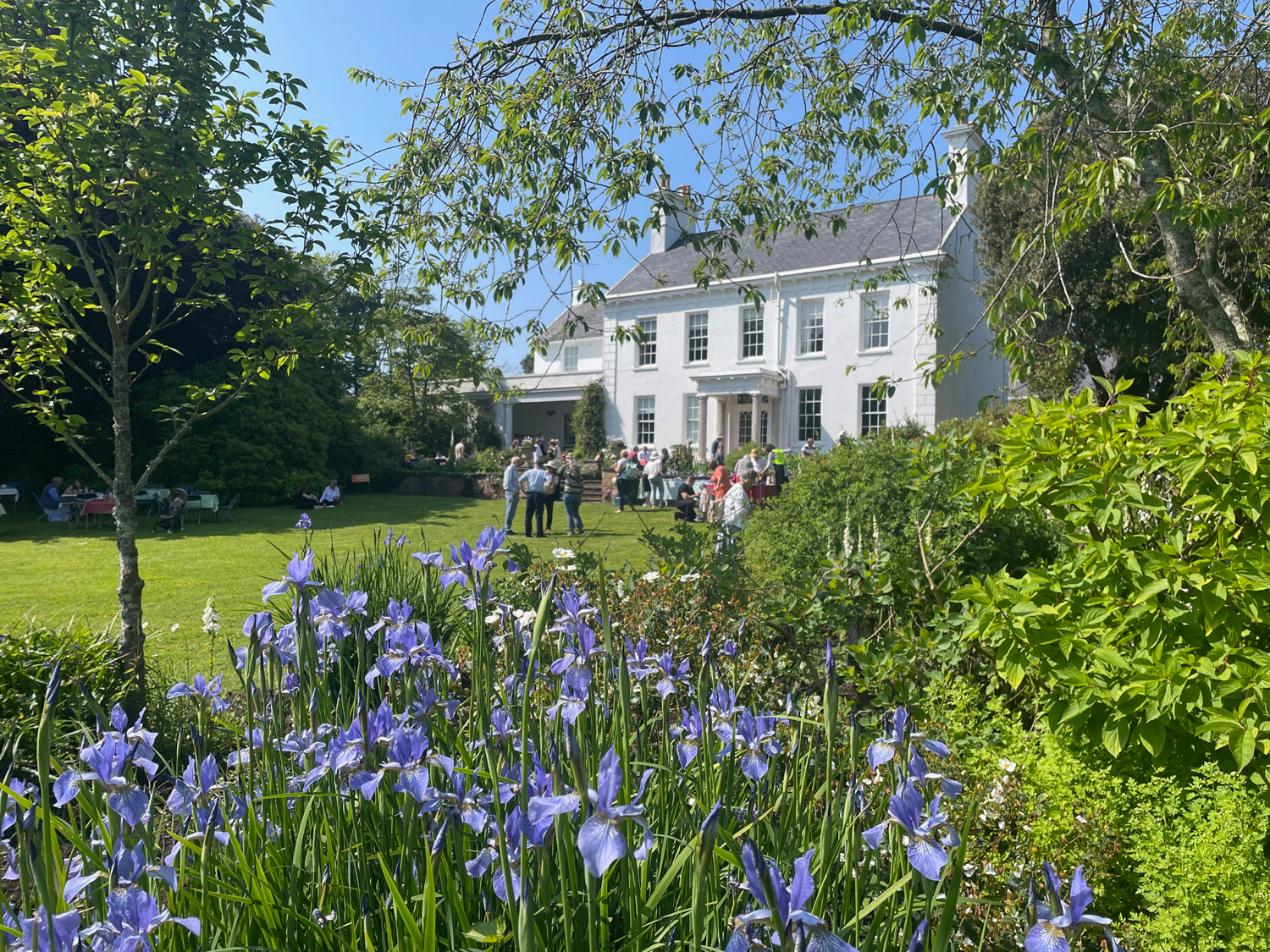
Oaklands, lunch with Simon and Melissa Bonn
Magnolia have been placed to view from the house by design, carefully chosen to spread the flowering season from February to May. Magnolia ‘Vulcan’, M. tripetela, M. denudata, M. ‘Peter Smithers’ M. ‘Elizabeth’ to name but a few. With an understanding of the prevailing wind, a shelter belt was planted on the western side of the garden, Pinus radiata, Tsuga heterophylla, Fagus sylvatica, Tilia x europea and Quercus robur. An understory Camellia cvs. have thrived in the sheltered acid conditions, as has Stachyurus japonica.
Oaklands has good representation of Island Champions, Magnolia doltsopa ‘Silver Cloud’, Juglans mandshurica var. mandshurica, Mespilus germanica, Crataegus crus-galli and Malus transitoria.
Simon and Melissa have nurtured the original planting, whilst their own knowledge and renewal is evident. Away from the formal lawns, they maintain a wildlife area amongst Nothofagus antarctica, Nyssa sinensis, Zelcova serrata, Acer griseum, Cercis siliquastrum and Ginkgo biloba overlooked by a Quercus ilex hidden in a mantle of runaway Clematis montana. We hope to see their new avenue of Almonds planted to replace a Wisteria sinensis badly strangled by its metal pergola.
A beautifully fluted Metasequoia glyptostroboides below the pond leads to Parrotia persica, a stand of Rhododendron luteum (A), Cercidiphyllum japonicum and a new collection of Acer to provide good autumn colour.
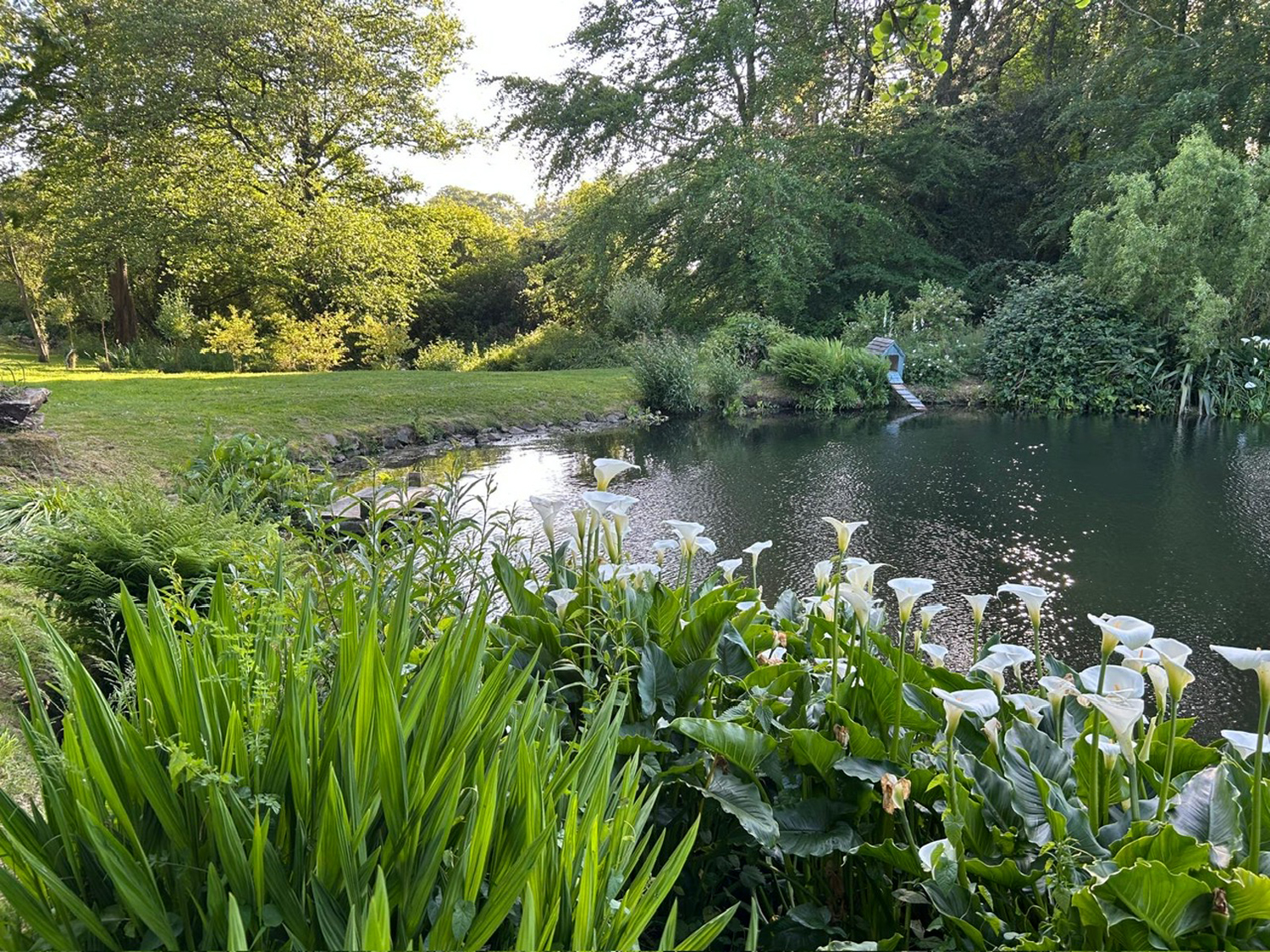
The pond at Oaklands
Closer to the house we find Myrus communis, Eucryphia glutinosa, Hoheria sexstylosa, Paraserianthes lophantha and a substantial Liriodendron tulipifera with a thicket of Drimyss winteri beneath.
Afternoon
St Ouen’s Manor
After lunch we will travel a short distance to St Ouen’s Manor where Charlie and Georgina Malet de Carteret will host tea and a tour of their estate.
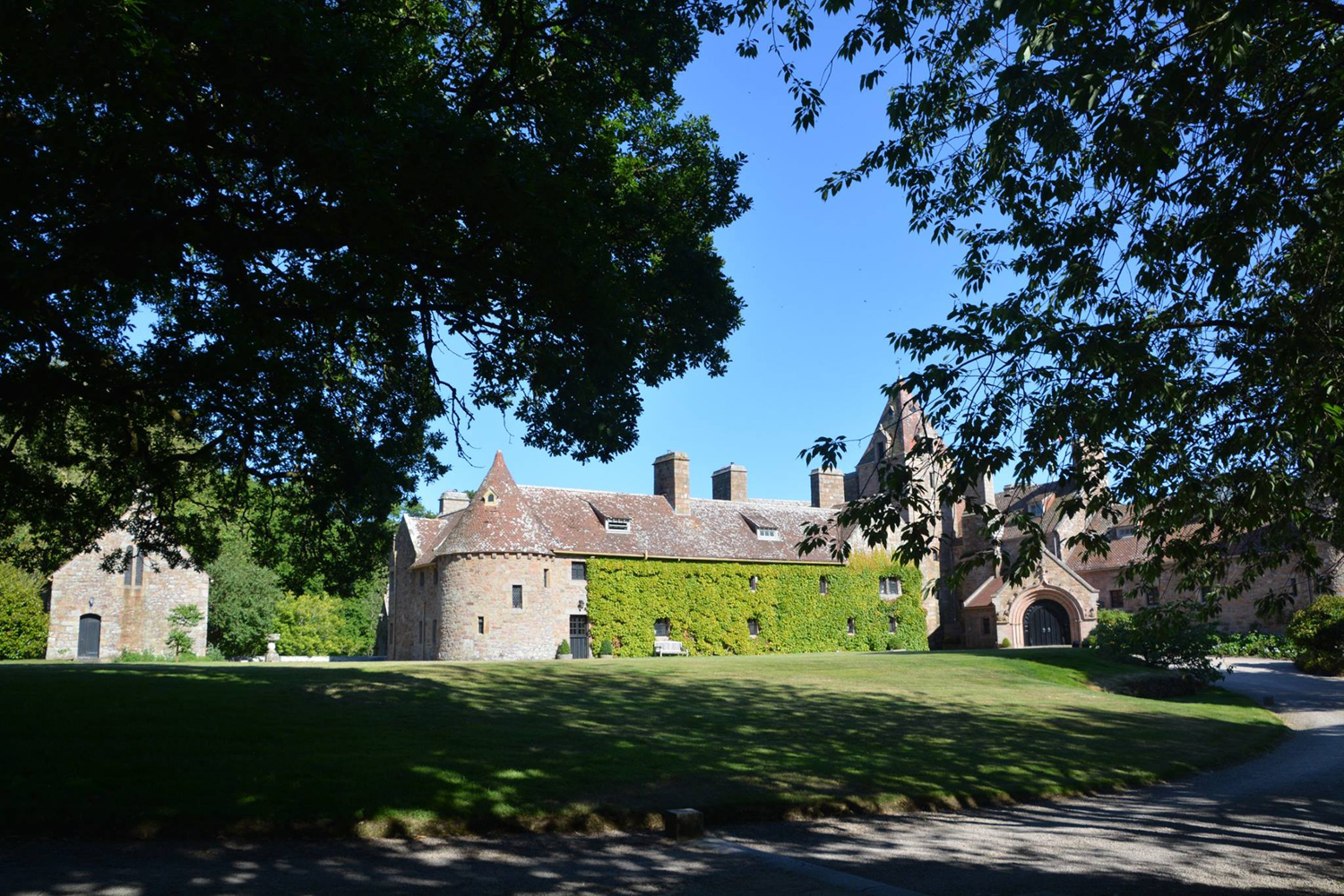
St Ouen’s Manor
This ancient manor and garden date back to the 12th century, home to the de Carterets, Seigneurs of St Ouen for over 600 years. The manor we see today is a rhythm of designs from the 15th, 17th and 19th centuries. Charlie is President of National Trust for Jersey, as Georgina was previously, both enthusiastic and knowledgeable custodians who have worked hard over the past 10 years to enhance the original 19th century planting of the manor grounds.
Within the nineteenth-century battlements, steps unite a series of lawns and terraces at different levels, the beds planted with roses, Magnolia grandiflora and a host of mainly white herbaceous plants for the weddings held here over the summer. The long East Terrace faces the 17th century façade, with two Jacobean style wings either side of the original Manor entrance overlooking a lawned moat.
There is a large Victorian walled garden with two colombiers built into the corners and a fountain in the centre circled by narrow paths lined with Lavendula angustifolia and Rosa ‘The Fairy’. A Liriodendron tulipifera is planted in the surrounding lawn and the warm walls play host to climbing roses including Rosa ‘Mme Alfred Carriere’ and Rosa ‘Mermaid’
Continuing to the Long Drive we will see veteran trees that escaped the German axe during the Occupation, Platanus x hispanica, Fraxinus excelsior, Castanea sativa, Fagus sylvatica, F. sylvatica Atropupurea group and Quercus robur. From here a view to the grove of Prunus ‘Tai-Haku’ where the grass is left long for the wildlife.
Continuing through a further wild-flower area is the Dame’s orchard and vegetable garden behind a beech hedge and further still, Alice’s Field, a collection of British native trees named after the Malet de Carteret’s daughter who was married in the chapel here and asked guests to donate a tree rather than give presents…. another keen dendrologist perhaps?
Return to Greenhills
Dinner at Greenhills in a private dining room.
Morning
Depart Greenhills by coach 9.15 am
Seafield House
We start the day at Seafield House, built in 1809 by Francois Giffard, a prosperous sea merchant of the time. Discretely hidden behind a wall of Brazilian gneiss, brought back as ballast on the cod trade ships, this impressive Greek revival Regency villa and substantial garden, which originally stretched to the sea, is now a green oasis in the desirable area of St Aubin’s Bay.
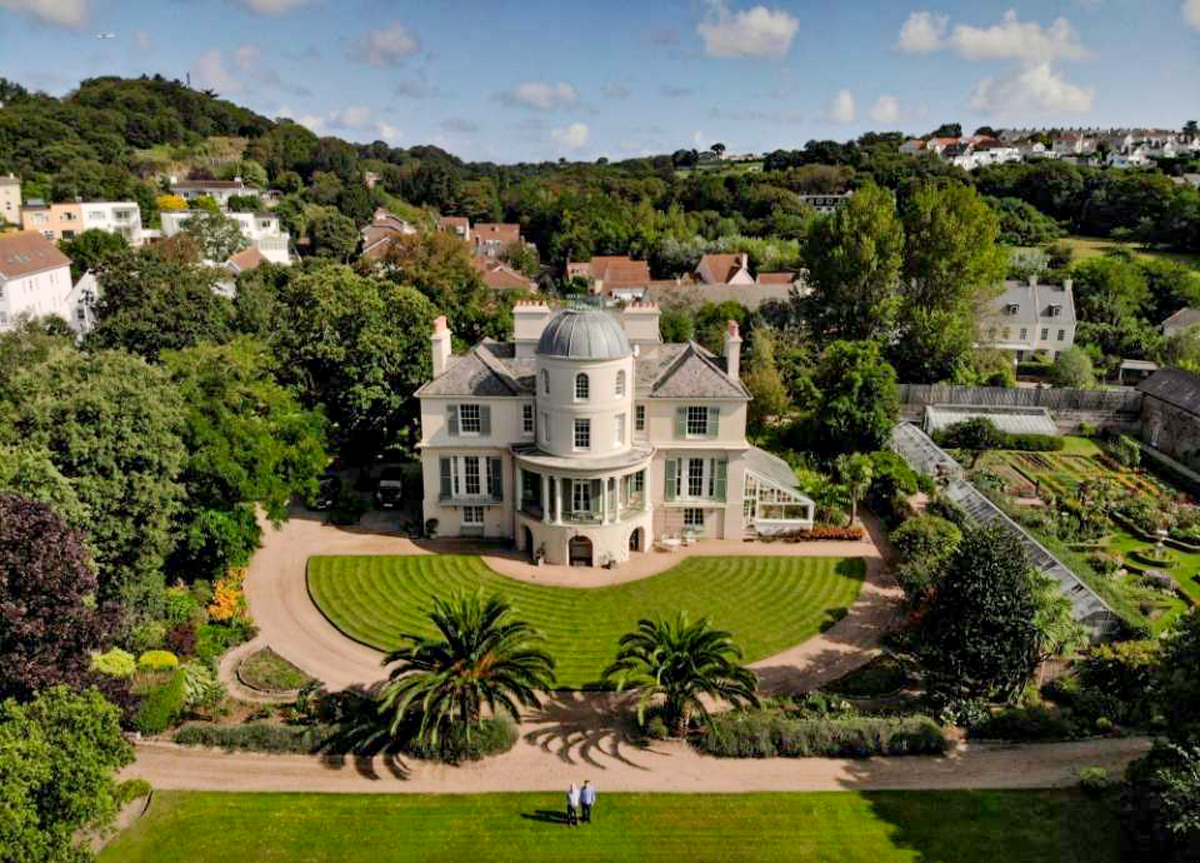
Seafield House, St Aubin’s Bay
Richard Miles, great grandson of Maxwell Vandeleur Blacker-Douglass, who moved from Ireland in 1921, is now the custodian of this historic house and garden, along with his wife, Sarah.
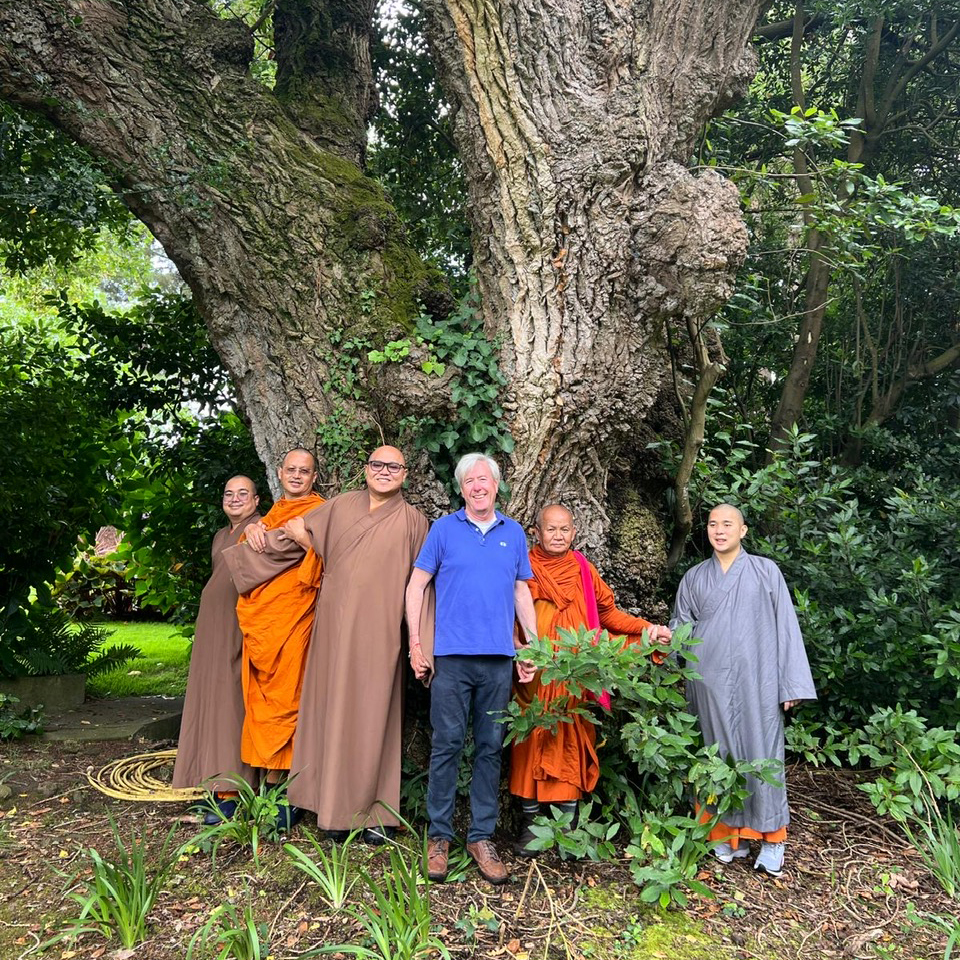
Richard Miles with Buddhist monks visiting his Populus nigra subsp. betulifolia
The original Regency garden layout of island beds containing shrubs and flowers stretches from the formal lawns below the house to a view now framed by a magnificent pair of Pheonix canariensis and a handsome Araucaria araucana. Gravel paths lead to a Victorian walled garden laid out with Buxus sempervirens filled with roses, where Eriobotrya japonica and a sumptuous Italian fig both fruit well.
A Local Champion Populus nigra subsp. betulifolia straddles a fast-flowing parish boundary, revered by Buddhist monks who are regular visitors to Seafield.
A valuable shelter belt of Pinus radiata was planted by Richard after considerable storm damage in 1987, which extends the original evergreen structure of the garden; Quercus ilex, Laurus nobilis, Camellia and variegated hollies to lighten the scene. Within this space of shadow and light, we will pass through various areas where Richard has been able to plant exotics such as Schinus molle, Arbutus unedo, Dicksonia antarctica and Musa basjoo, whose fibre is used in Japan for specialised paper and cloth.
Mid-morning Coffee
Domaine des Vaux
Proceeding inland to the centre of the Island, we explore the garden of Marcus and Anne Binney (IDS member) set in farmland down a secret valley to a spring fed pond and woodland beneath.
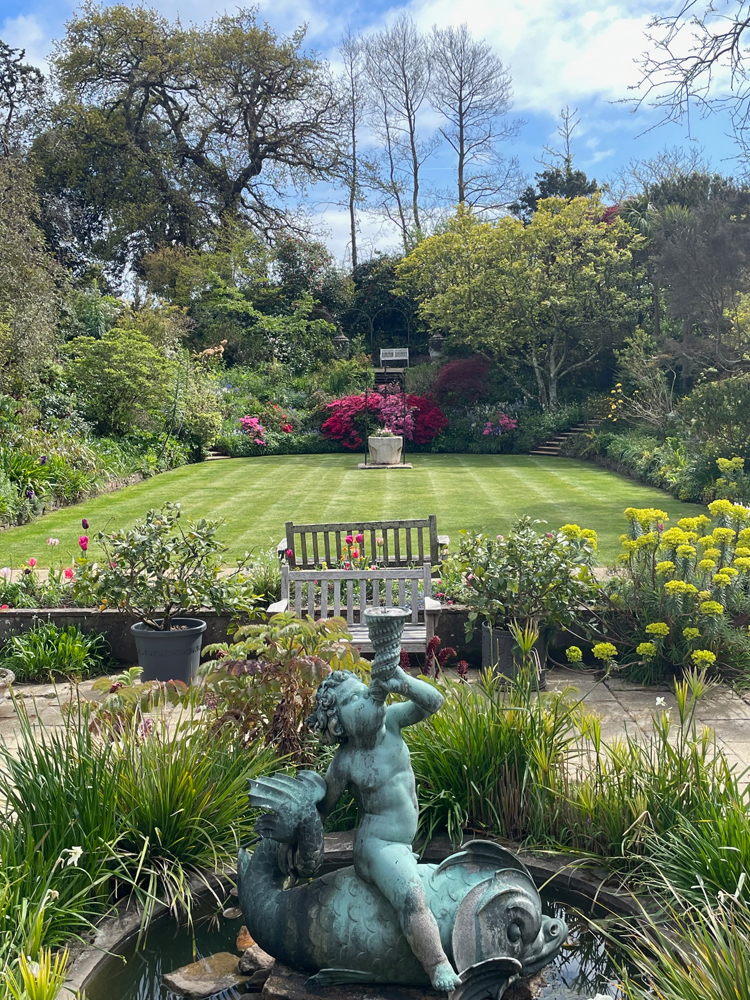
Arena Garden at Domaine des Vaux
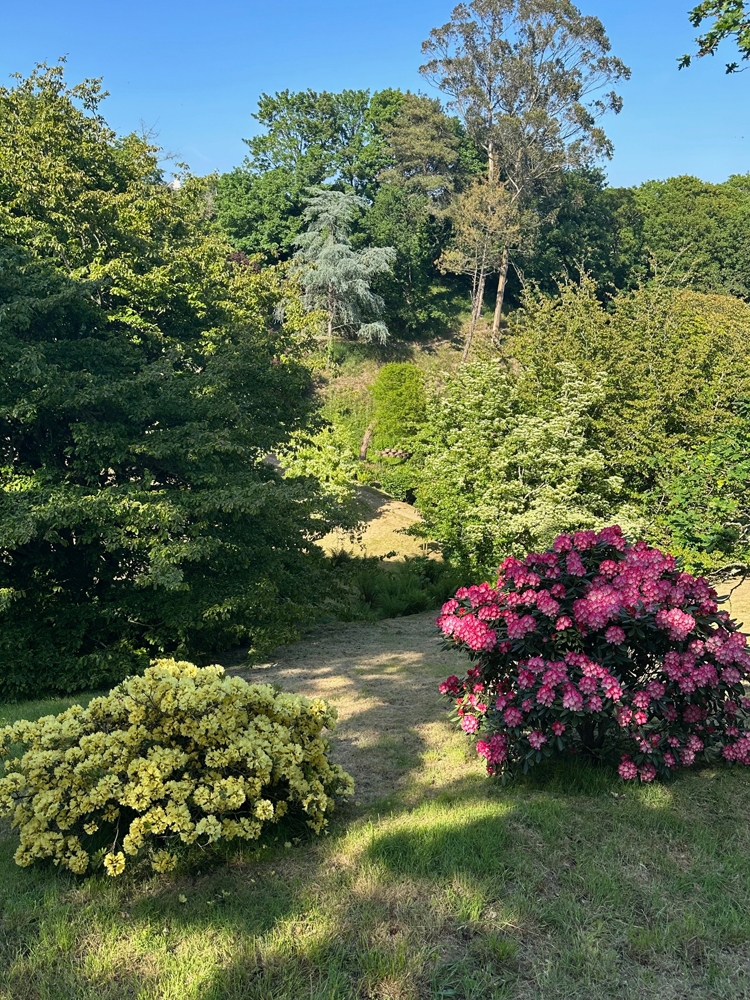
Valley at Domaine des Vaux
The traditional Jersey granite farmhouse dating back to early seventeenth century, with eighteenth-century extension, was bought by Sir George and Lady Binney (Marcus’ parents) in the 1970s. With a clear appreciation of the garden’s topography and natural elements, Lady Binney selected some fine specimen trees and a large collection of mature Trehane Camellia varieties, soaring as they might in their natural habitat. A large spreading multi-stemmed Magnolia campbellii thrives in the shelter of the lower valley, with Parrotia persica and Photinia cerrasifolia both displaying magnificent bark with space to spread.
The original garden layout has been embraced by Anne, who knowledgably sought favourable conditions for a continued legacy of choice planting. White flowered Oleander sp., Hibiscus syriacus and Fiscus cariaca enjoy the sunbaked bank before we follow a meandering path down the steep valley past Cornus kousa var. chinensis along with C. controversa ‘Variegata’ and C. ‘Eddie’s White Wonder’.
An Island champion Metasequoia glyptostroboides enjoys streams running from the top of the bank opposite, where a pair of towering Eucalyptus defied the destruction of some 20 trees in 2023. Below is a fascinating Taxodium distichum having grown to some 15 metres, begun to lean away from the shade of four Sycamore (now felled) growing in a determined manner towards the opposite bank. After 18 months, it lodged its apical stem into the bank and now grows epicormic shoots from the main trunk forming a natural arch.
Cercidiphyllum japonicum and another M. glyptostroboides overlook Dicksonia antartica and Gunnera manicata surrounding the pond. Pieris ’Forest Flame’ and Rhododendron luteum line the paths on the ascent towards a potager and greenhouse.
Close to the house, a mature Sophora japonicum shades a charming garden pavilion at one end of the terrace where Anne’s collection of citrus enjoy full sun, along with Acacia pravisima and a beautiful white flowering Wisteria floribunda. The lawn is enclosed by the Arena Beds planted with ericaceous shrubs, Eucryphia nymansensis, Magnolia ‘Yellow Bird’ and Leptospermum ‘Crimson Glory’.
Lunch
Le Clos du Chemin
We will hasten on to a buffet lunch at Le Clos du Chemin, generously hosted by Rupert Lea (IDS member).
This 1930’s villa commands a spectacular view over St Aubin’s Bay and Elizabeth Castle from the formal terrace and the southerly sloping lawns below. What we see today is mainly the work of Rupert’s mother Sue, a keen IDS member and traveller on many tours who gardened and guided visitors well into her 90s!
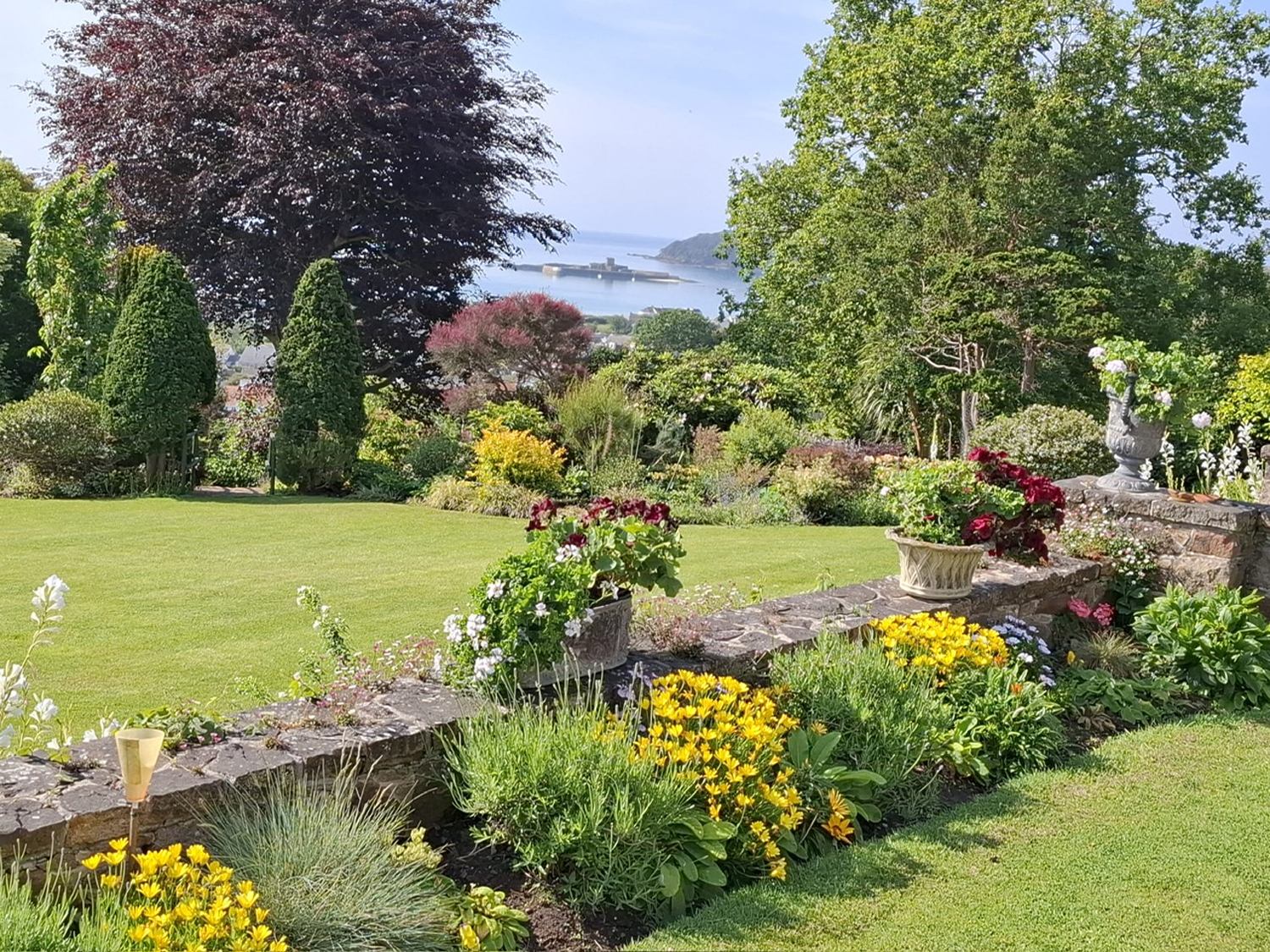
Le Clos du Chemin and lunch with Rupert Lea
Sue and her husband Robert inherited a garden badly devastated by the 1987 storms and set about redesigning and replanting in 1990. Leaving the chalky damp soil of their previous garden, they embraced these new conditions by planting a number of carefully selected Camellia and many Magnolia including M.lilliflora ‘Nigra’, M. ‘Vulcan’, M. ‘Susan’ M. stellata cultivars which have been added to by Rupert, believing these to be the most robust in this landscape.
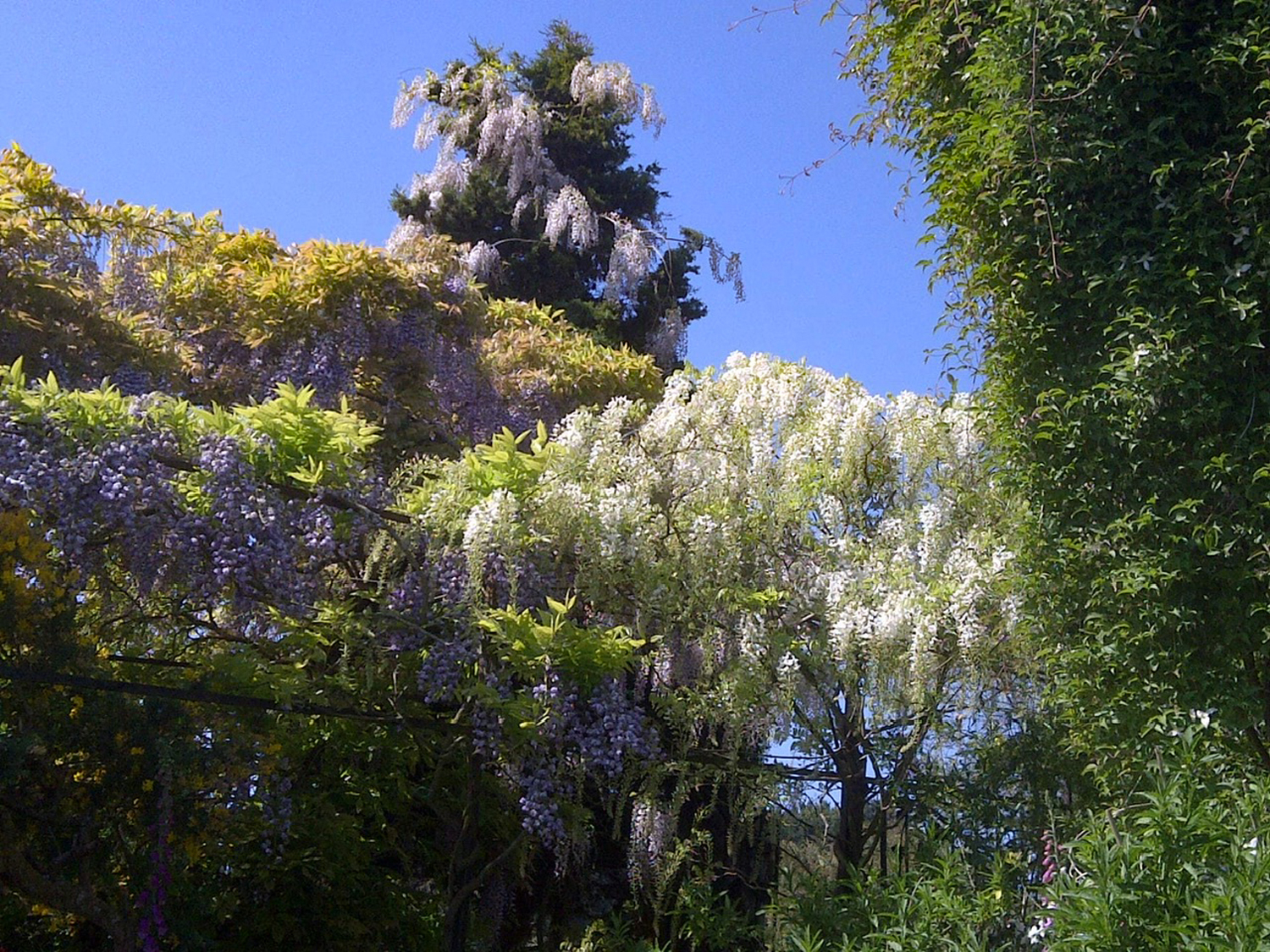
Wisteria at Clos du Chemin
With the challenge of the purposeful south-westerly winds, Rupert has pruned a lot of the ageing trees and shrubs to avoid limbs tearing, with pleasing results in most showing new vigour and a better suited physique. He has also removed less healthy trees and shrubs fallen victim to the resident Phytophthera ramomorum.
We shall enjoy the Cercis siliquastrum at the far end of the garden, flanked by two white flowering varieties, a Magnolia laevifolia, Stewartia pseudocamellia, Paulownia tormentosa, Ginkgo biloba, Parrotia persica, Hoheria angustifolia, Koeltreutia paniculata, Lagestroemia indica, Eucryphia lucida, and Eriobotrya japonica.
Rupert has enlarged the collection of Leptospermum and planted a group of Prunus ‘Amanogawa’, with a variety of Prunus incisa and Chaenomeles reflecting on his many years spent in the Far East.
Afternoon
La Hague Manor Arboretum
La Hague Manor (now St George’s Preparatory School), dates from 1060, named after the fourteenth-century owner, Onfroi de la Hague. The present house dates from 1753, bought in 1871 by Colonel C.P. Le Cornu, ADC to Queen Victoria, who altered the house substantially and is thought to have planted the arboretum.
Recognising the potential of the sheltered twin valleys running steeply from the formal lawns surrounding the house, he embraced the availability of newly introduced species and set about creating the finest arboretum in the Channel Islands.
Anne Haden (IDS member) will guide us. She knows the property well and has been updating the Champion Trees in Jersey in conjunction with Jersey Trees for Life.
The 1987 storm took its toll on a few Champions, including the original Araucaria araucana, a splendid replacement thrives on the lawn, the Quercus ilex has been heavily pollarded (school health and safety) and a belt of Pinus radiata took a hit in Storm Ciaren. A fine Cedrus atlantica stands well against the remaining pines and an Island Champion Prunus ‘Amanogawa’ is still hanging in there!
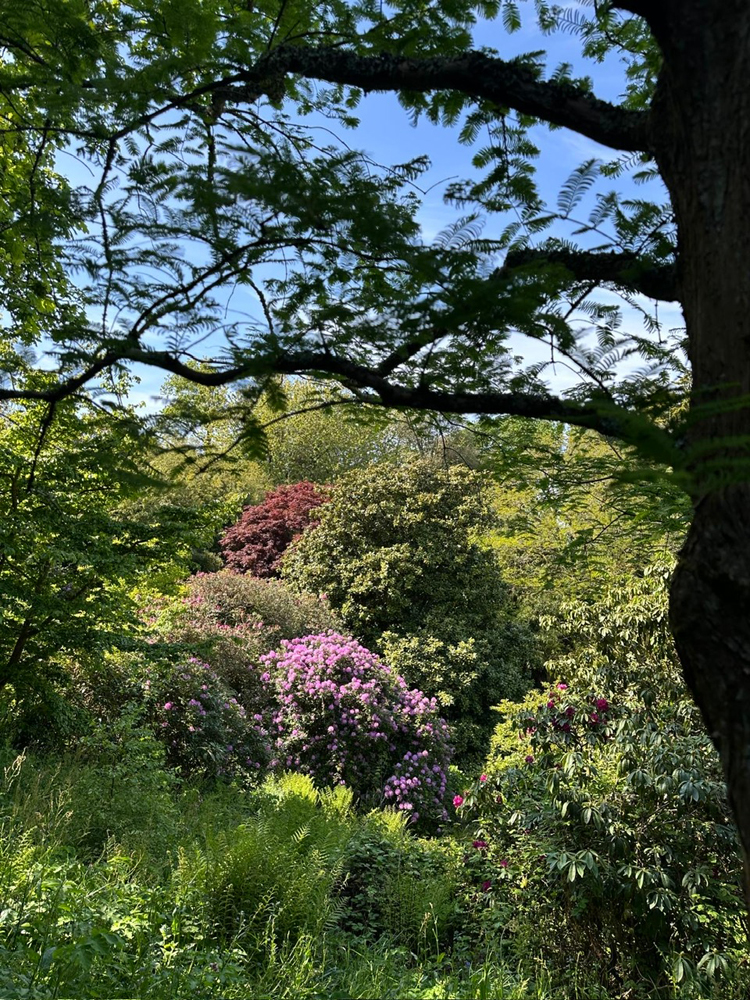
La Hague Manor valley
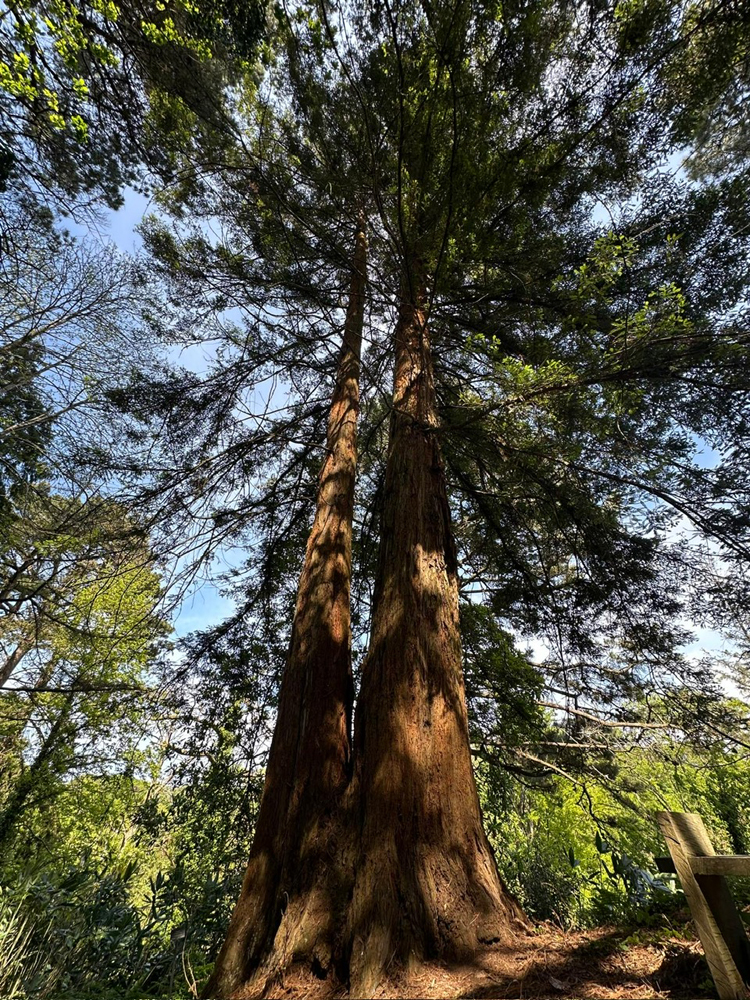
Sequoia sempervirens at La Hague Manor
In the sheltered valley, we will descend along the path through Magnolia, Rhododendron sp., Acer davidii and Acer opalis. The stream provides good conditions for Salix × sepulchralis, Taxodium distichum and Populus nigra ‘Italica’. A public path enables Jersey residents to enjoy the sizeable Pseudotsuga menziesii and Sequoia sempervirens close to the path which continues past a Champion Photinia serratifolia to the second valley where a Picea sitchensis claims to be the tallest tree in Jersey.
Mature Oaks, Quercus robur, Q. castaneifolia and Q. ilex are planted in the grounds along with a number of commemorative trees including an Oak from a Royal acorn from Windsor.
We drive from here to the exposed windblown 5 mile bay of St Ouen on the west coast for an informal beach café supper and the hope of a sunset!
18.30 Dinner at Le Braye, St Brelade
21.00 Return to Greenhills
Morning
Depart Greenhills by coach 9.15 am
Meadow Farm
We will make a short visit to Anna Bradstock’s home, Meadow Farm, an eighteenth-century granite farmhouse in a tranquil valley on the north coast. Anna grew up in Jersey, lived in Berkshire for thirty years and moved back to the Island seven years ago. Her husband’s wish for a sea view was gently steered towards this sheltered garden, avoiding the worst of the wind, just a short walk to the sea.
The previous owners made sunny terraced garden close to the house overlooking a central pond fed by the valley stream planted with a Salix babylonica, Salix exigua and Dicksonia antartica. Paths and steps were created through the scrubby post-war oak and sycamore woodland where red squirrels thrive, the greys have thankfully not made the strict Jersey residency qualifications! Quercus rubra, Betula pendula, a Myrtus communis, Metasequoia glyptostoboides, Ginkgo biloba and Wollemia nobilis were also planted.
Excited to garden in the Gulf Stream and mainly acidic soil, Anna resisted the Island’s allure of filling the plot with too many magnolias, rhododendrons and camellias, in an effort to extend the interest further into the summer, when most visitors come to stay. Magnolia ‘Star Wars’ has rocketed, M.’Genie’ offers flowers over several months, M. ‘Susan’ from B&Q, reveals the limitations of local nurseries; Meliosma veitchiorum and seed grown Acer were sneaked into the furniture van from the UK.
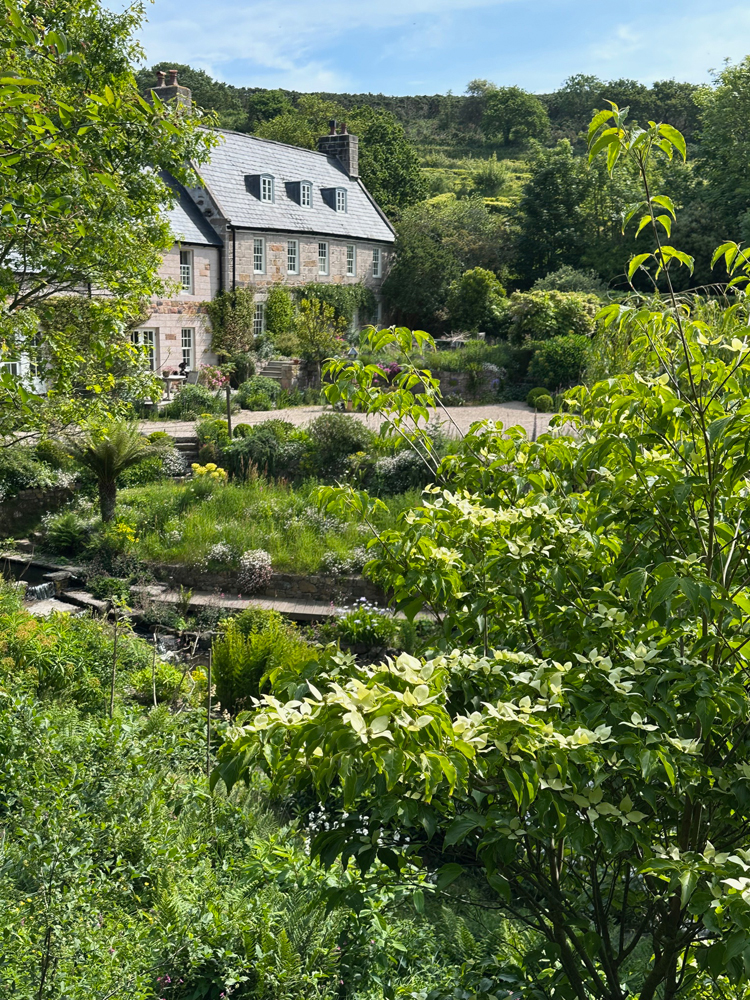
Meadow Farm with Cornus kousa var. chinensis
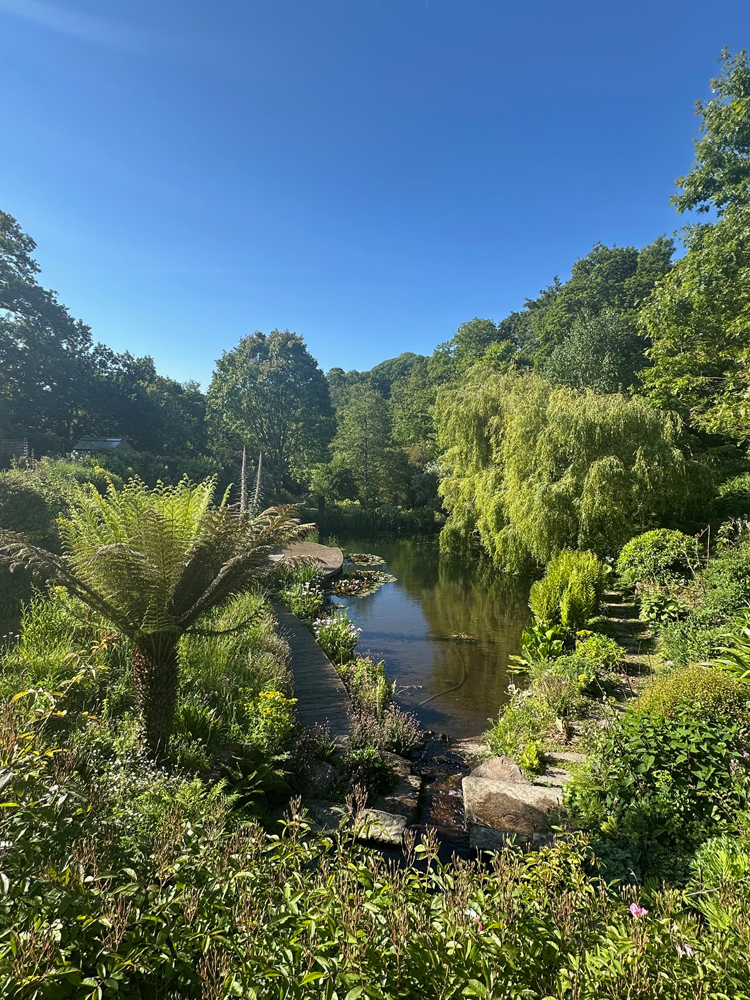
Pond at Meadow Farm
The steep terrain, ‘cotil’, has been a challenge for planting, and Storm Ciaren in 2023 provided a whole new area, now home for to some souvenirs from the IDS Western Brittany Tour 2025, Rhododendron ‘Halopeanum’, Magnolia wilsonii, Cornus hongkongensis and Heptacodium miconioides.
Easing into the woodland landscape with Euonymus ‘Red Cascade’, Virburnum opulus, Hydrangea paniculata and Amelanchier × lamarkii, the aim was to give the more exotic species a more ‘comfortable’ context within the natural landscape. Ekianthus campanulatus, Crinodendron hookerianum, Rhododendron fragrantissima, Cercis canadensis ‘Forest Pansy’, Calycanthus ‘Aphrodite’ C. ‘Venus’, Aesculus parviflora, Pittosporum tobira, Tetrapax papyrifer, Cornus kousa var. chinensis, C. ‘Venus’ C. ‘China Girl’, C. ‘Porlock’ may well be starting to flower.
Stewartia pseudocamellia, Styrax japonicus, Eucryphia lucida ‘Ballerina’, Albizia julibrissin, Heptacodium miconioides, Arbutus unedo and Myrtus communis subsp. tarentina carry the garden through the summer months to an autumn display from Liquidamber styraciflua, Cercidiphyllum japonicum and Sorbus commixta ‘Olympic Flame’, unless the gales get there first!
Trinity Manor
We travel a short distance in the same parish to Trinity Manor, home of Paul and Pam Bell for over 20 years. Dating back to the 16th Century, the manor with accompanying Seigneurial title, sits in the centre of 150 acres of parkland and thriving dairy herd of Jersey cows. The house we see today, with its striking French roof, was designed by Reginald Blomfield, influenced by a journey he took to St Malo with the owner, Athelston Riley in the early 1900s. The main elements of the formal garden surrounding the house remain from Blomfield’s original design, as do some of the original Camellia and Magnolia and the pleached hornbeam hedge enclosing a stone fountain and clipped yew added latterly.
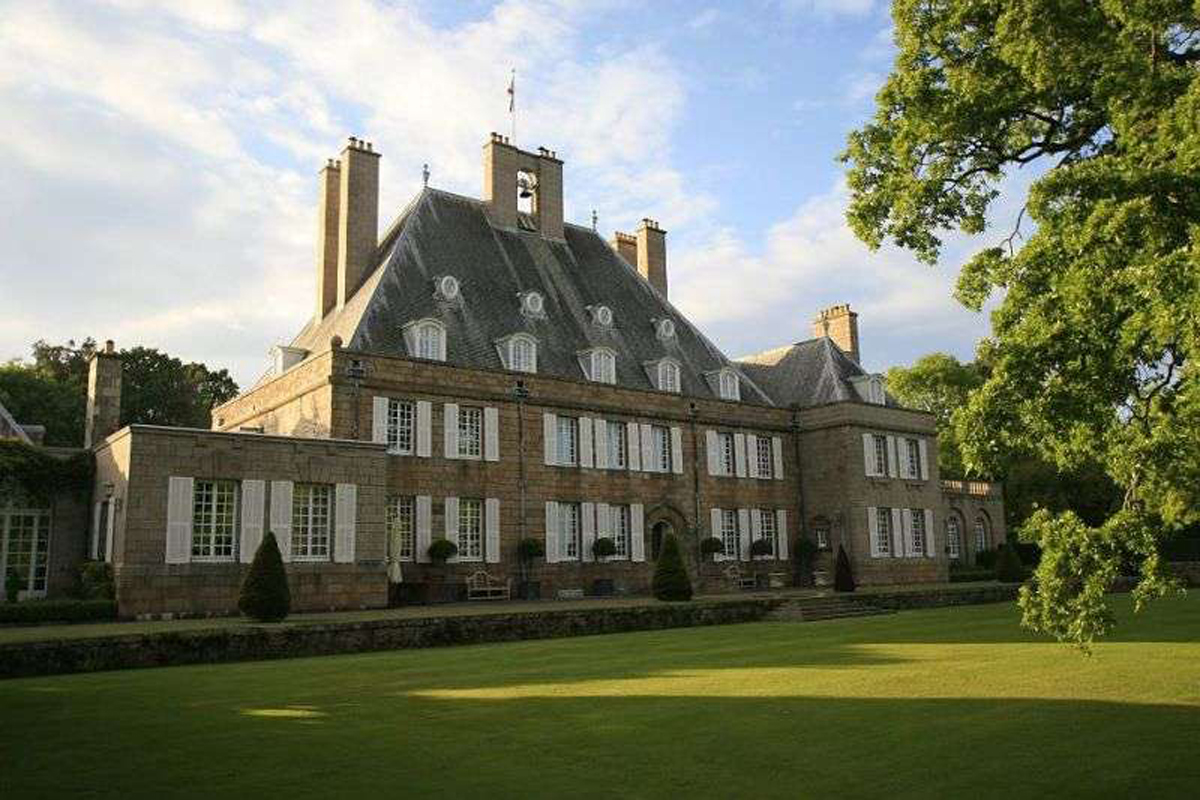
Trinity Manor
The magnificent Lucombe oak, Quercus × hispanica ‘Lucombeana’, dominates the southern lawn below the house. A hybrid of Q. cerris × Q. suber raised by an Exeter nurseryman Lucombe in 1763, might suggest that the tree is in the region of 250 years old, known to predate the Blomfield house.
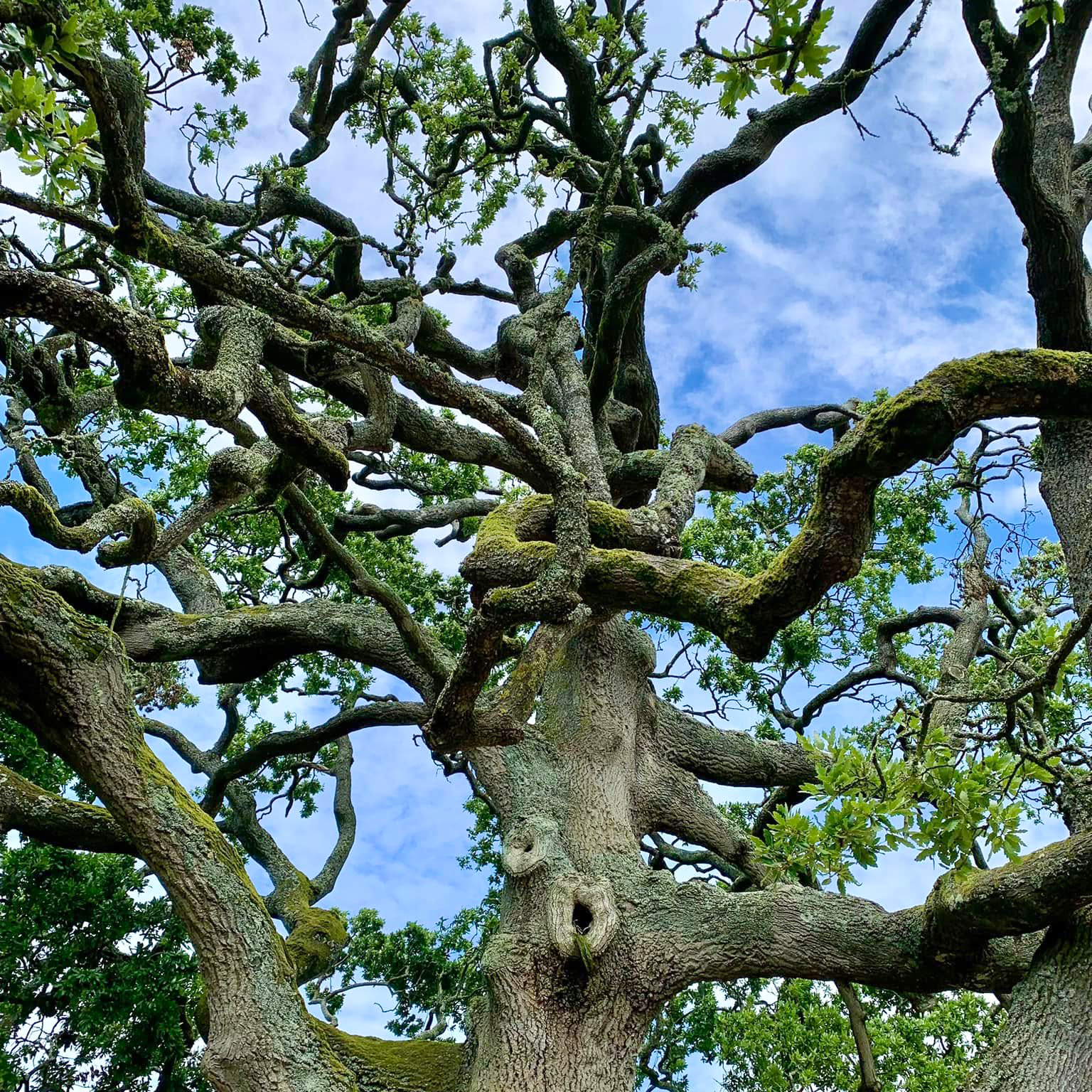
Lucombe Oak at Trinity Manor
A canal, accessed by a pair of Jersey granite tourelle stairs, feeds a large pond set in the bosquet area, which has been richly planted by the Bells with a variety of parkland tree with a thriving group of Metasequoia glyptostroboides.
The Victorian walled garden was neglected by subsequent generations of the Riley family, choosing instead to graze their horses there. Tom Stuart-Smith designed a series of rooms which have evolved towards a planting of Mediterranean species by the Bell’s own staff, which cope with this very hot area in the summer. Clipped Prunus lusitanica, gnarled Olea europaea and Phillyrea angustifolia sit within the yew hedging and a fine selection of roses and climbers adorn the walls.
The Folly garden which leads back to the main courtyard holds some of the original plants, a fine Magnolia campbellii, Camellia cvs. Rhododendron hybrids, Celtis laevigata, Fuchsia excorticata, Oemerleria cerasiformis and Leptospermum.
The entrance forecourt on the north side is planted with Buxus sempervirens in a formal parterre, surrounded topiarised Prunus lusitanica and tender climbers enjoying the walled enclosure.
Lunch
Rosel Manor
We continue eastwards to Rosel Manor, where Emma and Stewart Johnston will generously host lunch. Emma is the 6th generation of Lempriere to have lived at Rosel.
The original manor house was situated at the head of a valley next to the colombier, above the charming twelfth-century chapel of St Anne overlooking a pond, historically stocked with carp for the household to eat on Fridays.
The existing manor sits on the hill of St Marguerite, a square granite house, built in 1770 by Charles Lempriere, who served as Solicitor General and Lieutenant Bailiff. His grandson, Philippe, covered the granite with Roman cement, adding turrets and castellations, as was the rage in early 1800s.
As Dame de Rosel, one of Emma’s ceremonial duties is to serve the visiting English monarch wearing white gloves, lunch today will be a less formal affair and as it is not Friday, no carp!
After lunch we will enjoy a tour of the garden.
The original garden was laid out by Charles and Elizabeth Lempriere (circa 1820) with formal lawns surrounding the house, a walled garden to the east and a woodland path down the steep slope to the sheltered valley garden below. A fine collection of these original magnolias, camellias and rhododendrons were added by an Uncle John Bolitho in 1950s, taking inspiration from his native Cornish gardens.
Looking towards the chapel across the pond framed with arum lilies, a towering Taxodium distichum is rooted on pond edge. This is an intermittent champion, depending where lightning strikes in the British Isles, this one has lost its top twice!
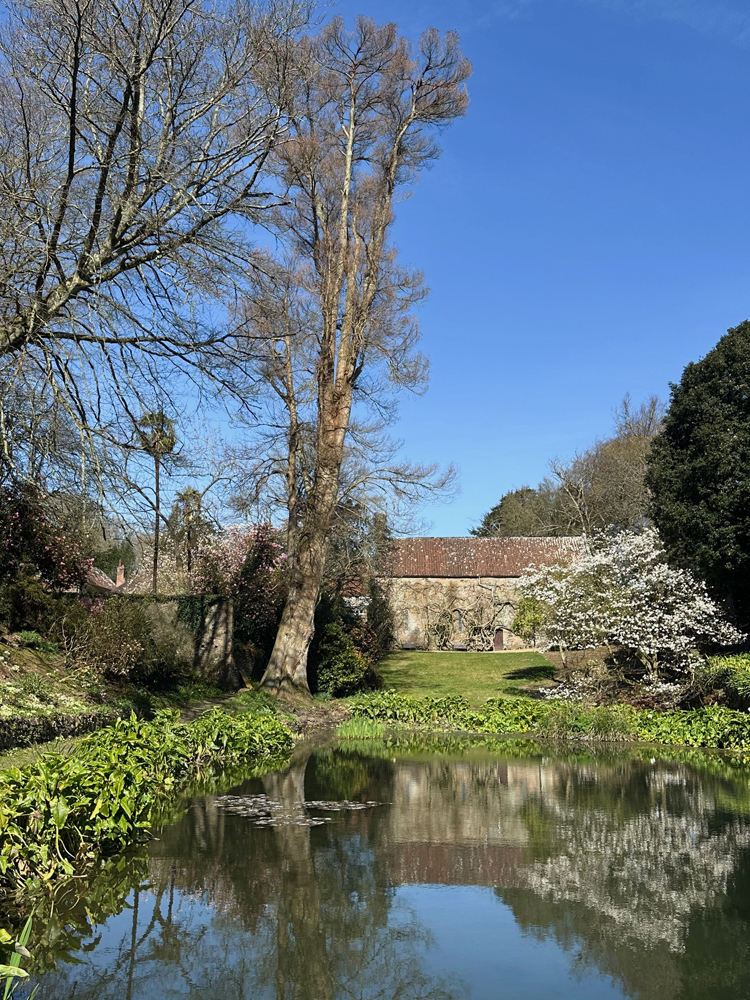
Rosel Manor main pond with champion Taxodium distichum
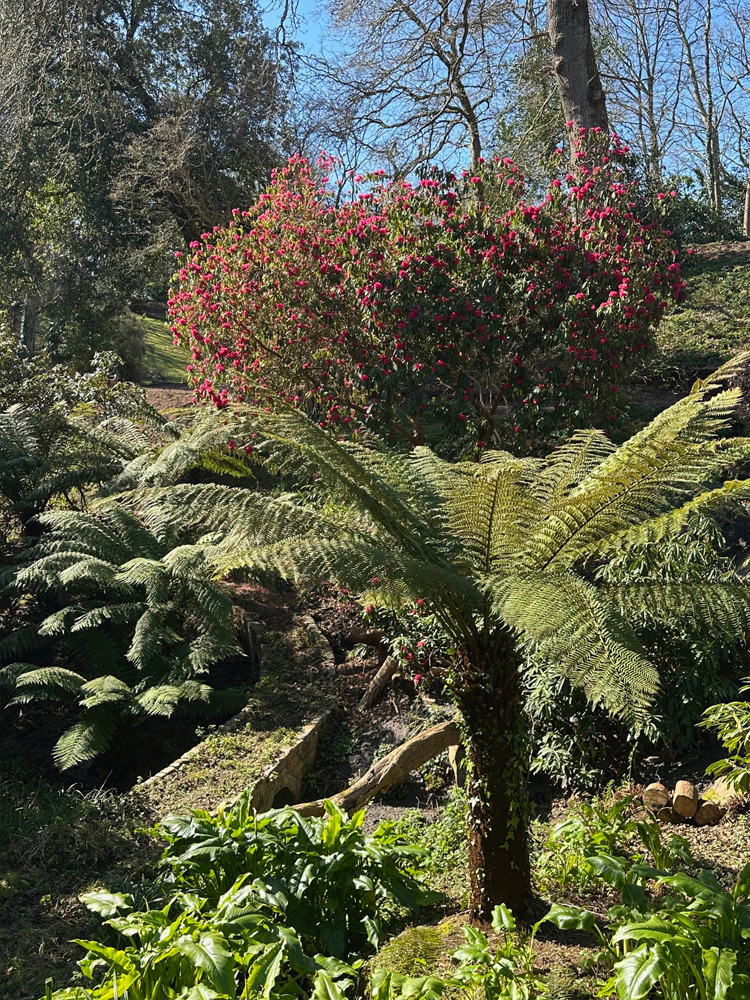
Dicksonia antartica
West of the chapel, an Island champion Magnolia × soulangeana ‘Alba Superba’ layers its python-like branches at the entrance to the Palm Garden, named after the four champion Trachycarpus fornunei planted within. Here we also find a champion Euonymus lucidus, a Drimys winterii, Magnolia × campbellii var. mollicomata, Magnolia ‘Elizabeth’ and Emma’s Mediterranean garden where Musa share this suntrap.
The steep banks either side of the main pond have been cleared of Rhododendron ponticum which had overpowered many of the original Rhododendron hybrids. Additional clearing of a more drastic nature followed damage from Storm Ciaren (2023) when three veteran beeches littered the pond.
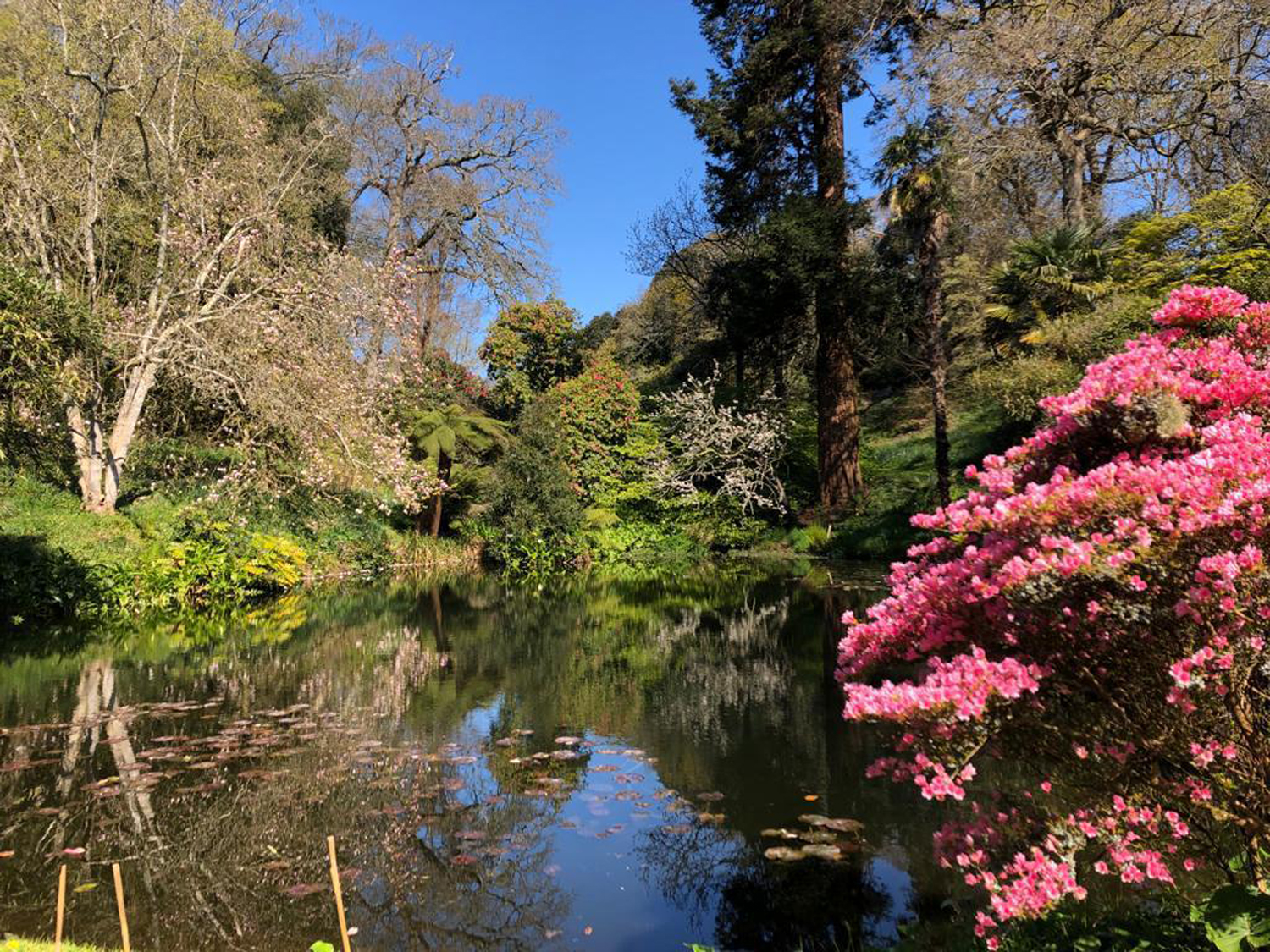
Rosel Manor lower pond with Sequoia sempervirens and Magnolia campbellii ‘Lanarth’
Existing Camellia, Hoheria sexstylosa, Pieris japonica, Kurume azelea play host to new plantings of Crinodendron hookerianum, Rhododendron ‘Cunningham’s White’, Cornus ‘Eddie’s White Wonder’, Hydrangea paniculata ‘Phantom’, azeleas, Cercis canadensis ‘Eternal Flame’ and a selection of Japanese acers.
Continuing our walk down the valley, the narrow stream to a lower pond forms the perfect gorge for Dicksonia antarctica to naturalise, sheltered by arboreal Rhododendron. Passing a newly formed stumpery, Magnolia × campbellii ‘Lanarth’ and M. × soulangeana ‘Rustic Rubra’ indicate the Cornish Uncle’s influence which spreads further down the old sanctuary path that runs from the chapel to the refuge of the sea, just half a mile on through the woods.
Paulownia tormentosa, Magnolia × campbellii ‘Lanarth’ an Metasequoia glyptostroboides seem tall until we meet champion Rhododendron sinogrande and Drimys winteri at the end of this area of garden. On the return loop of the lower pond Embothrium coccineum, Kalmia latifolia and Cornus kousa feature as understory, overlooked by an Island champion Sequoia sempervirens, defiant of the climatic and historic storms of the past century.
Afternoon
Rozel Fort
Our last destination is Rozel Fort, home to Nigel Deering (IDS member) and Kim Turberville, who have lived here since 1997.
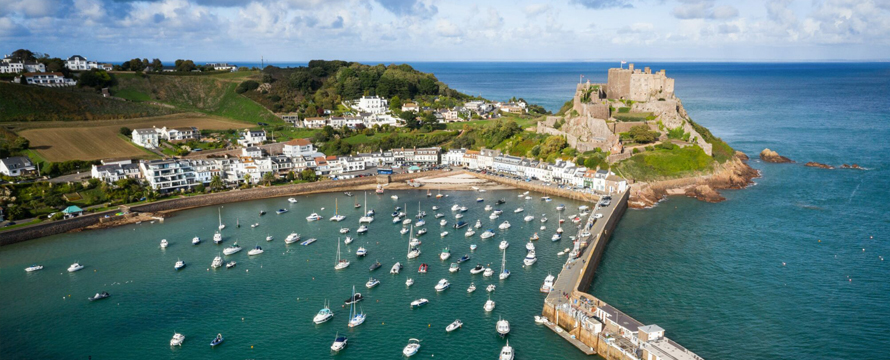
The fort sits on a headland next to Rozel harbour in the north-east corner of the Island looking towards France and the Ecrehous reef. The nineteenth-century guard house, built to defend the harbour from the French, was first converted into a home in the 1920s. Military paths leading to batteries and lookout points now form garden routes with echoes of the military past.
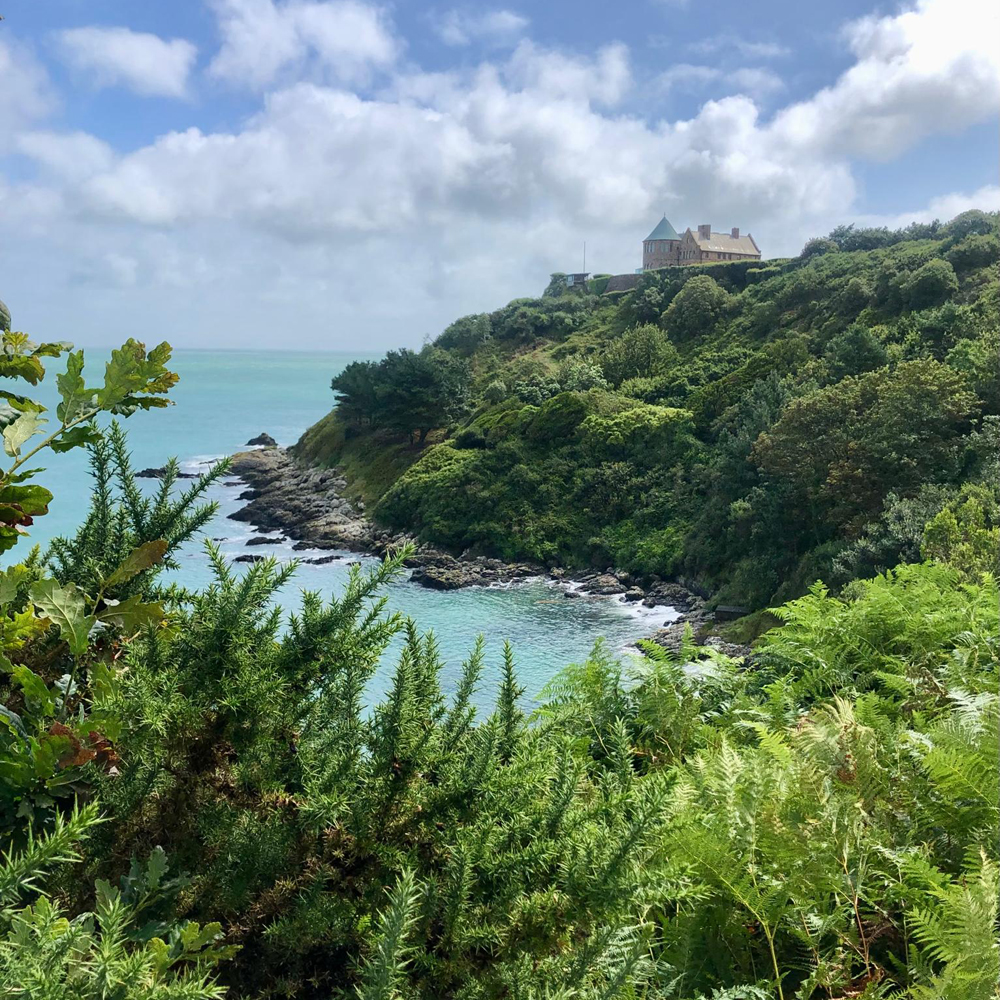
Rozel Fort from northwesterly aspect
On the south facing slope, Nigel and Kim have cultivated a Mediterranean terraced garden overlooking the harbour. Vegetable gardens are bordered with clipped Myrtus communis subsp. tarentina and buttresses of Osmanthus × burkwoodii running underneath Quercus robur pruned at a height to keep sightlines clear around the house.
Further trees faring well in this coastal location include Metrosideros excelsa, Amelanchier canadensis, Pinus radiata, Pinus sylvestris and Pinus muricata. The recent storms Ciaran and Goretti have been helping to remove the tallest Pinus radiata and Eucalyptus globulus.
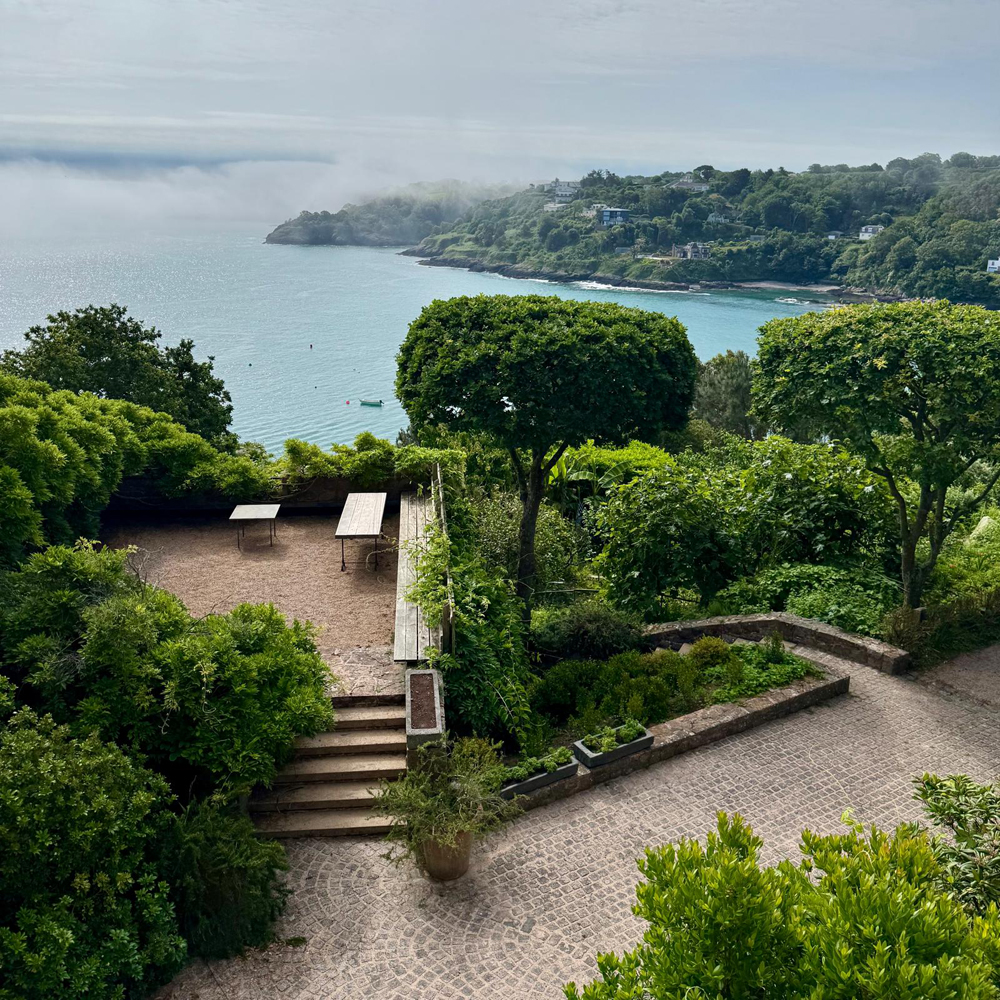
Rozel Fort battlement garden overlooking the harbour
Veteran survivors of the German occupation tree felling include a large multi-stemmed Quercus ilex and a resilient Wisteria sinensis growing along the loop-holed wall defending the land direction. This is a hot dry area loved by the wall lizards and other plantings include Clethra arborea, Choisya ternata and Wisteria floribunda.
Surrounded by the sea on three sides there is woodland planting on the Western slopes facing the prevailing winds. Quercus robur and Quercus ilex do best here, with old Taxus baccata providing protection for Magnolia campbellii ‘Charles Raffill’, Liriodendron tulipfera and Zelkova serrata.
On the top of the headland, trees are kept low, a line of Quercus cerris and Quercus robur, opposite plantings of Quercus x hispanica ‘Lucombeana’, Castanea sativa, Ailanthus altissima and Quercus palustris. All have been able to grow slowly in the rock here which is called Rozel Conglomerate, a sedimentary rock with volcanic fragments which is particular to the north-east corner of the Island and known locally as pudding stone.
We hope to share a glass of wine enjoying the spectacular views of France and the other Channel Islands from this unique lookout so lovingly maintained by Nigel and Kim.
Final buffet dinner at Greenhills in a private dining room.
Breakfast at Greenhills and check-out by 11 am for those not extending their stay.
| Location | Jersey, Channel Islands |
| Tour dates, arrival | Monday 3 May 2027 |
| Tour dates, departure | Friday 7 May 2027* |
| Accommodation | Greenhills Country House Hotel |
| Tour organiser | Anna Bradstock |
| Tour coordinator | Anthony Dessain |
| Availability | Tour restricted to 25 participants |
| Accessibility | Waking difficulty: 2 (easy with mostly short walks of less than 2 km, occasional uneven ground) |
| Weather conditions | May promises increasing sunshine, mild spring weather, with a possibility of showers. Temperatures between 16 C to 9 C |
| Transport | Flights Ferries |
| Tour cost | £1,250 per person (based on two people sharing) A deposit of £400 per person will be payable by 8 November 2026. |
| What’s included? | Hotel accommodation for 4 nights, all meals, wine at dinners, 2 drinks receptions, scheduled excursions, tips. |
| What’s not included? | Travel to and from Jersey, insurance, drinks other than those included above, and any extended stay. |